
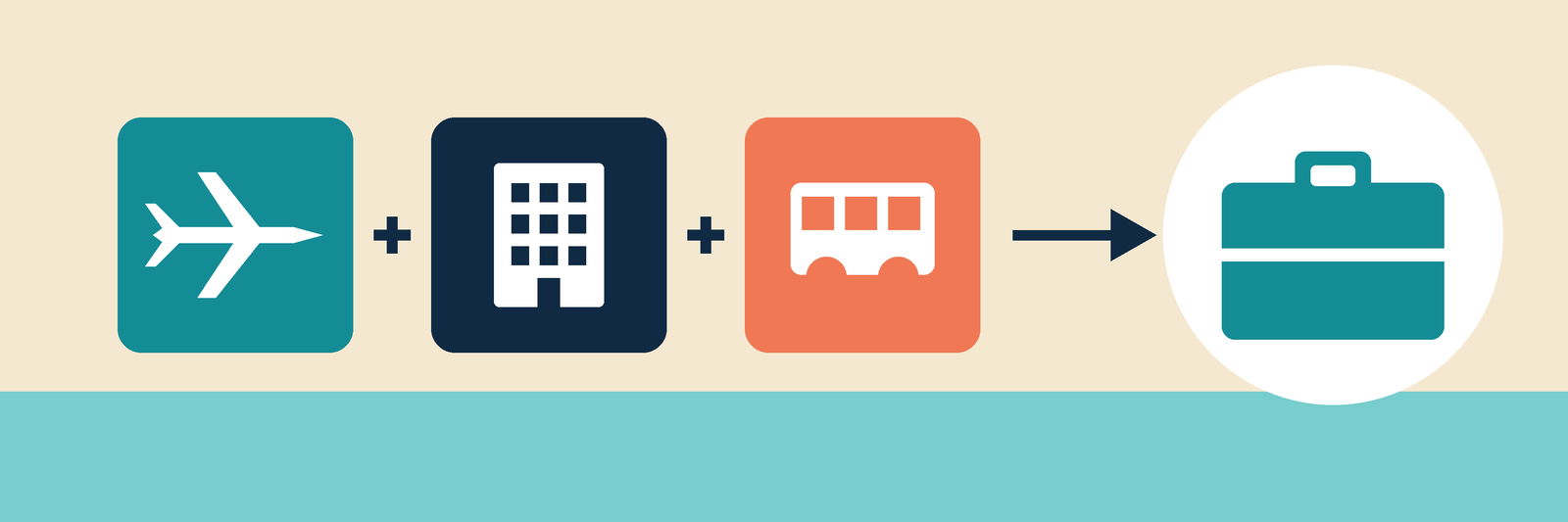
What is dynamic packaging in travel?
Dynamic packaging is the process of building a holiday at the moment a customer searches, by combining separately sourced components such as flights, accommodation, transfers and extras into one package with one price. Nothing is assembled in advance. The system checks live availability and cost for each component, applies the operator's pricing rules and returns a bookable holiday in real time.
It lets tour operators offer far more choice than a pre-built programme allows: any departure airport, any duration, any date the suppliers can support. It also changes how operators manage risk, margin and technology. This guide covers how it works, where it differs from traditional packaging, and why most large operators now run a hybrid of the two.
How dynamic packaging works
From the customer's side it looks simple. Behind the search box, five things happen in a second or two.
-
Search. The customer enters a destination, dates, duration, departure airport and party size.
-
Source. The platform gathers flight options and accommodation options from the operator's own stock and from connected suppliers.
-
Combine. A packaging engine pairs valid flights with valid stays, adds transfers and other included items, and discards combinations that break the operator's rules.
-
Price. Markups, margins, promotions and supplements are applied to the live cost of each component to produce a single package price.
-
Book. When the customer chooses, the platform confirms each component with its supplier and creates one booking record for the whole holiday.
The quality of a dynamic packaging system comes down to how well it does the middle three steps at speed: how many sources it can draw on, how intelligently it combines them, and how much control the trading team has over the price.
Dynamic packaging vs traditional packaging
|
Traditional (pre-packaged) |
Dynamic |
|
|---|---|---|
|
How the holiday is built |
In advance, from contracted flights and rooms |
At the moment of search, from live components |
|
Inventory |
Committed or allocated stock, often bought at risk |
Sourced on demand, usually no commitment |
|
Durations and dates |
Fixed patterns such as 7, 10 and 14 nights |
Any combination suppliers can support |
|
Pricing |
Set in advance, adjusted by the trading team |
Calculated live from component costs and rules |
|
Margin |
Usually stronger on directly contracted product |
Usually thinner on third-party product |
|
Commercial risk |
Higher: unsold commitments cost money |
Lower: pay only for what sells |
|
Product control |
High: chosen hotels, agreed standards |
Varies with the supplier |
Neither model wins outright. Contracted product gives control and margin but ties up capital and limits choice. Dynamic product gives range and flexibility, with less control and usually less margin. That trade-off is why the industry has moved to a blend.
What is hybrid dynamic packaging?
Hybrid dynamic packaging combines an operator's directly contracted inventory with dynamically sourced inventory in the same search, the same package and the same booking. A customer might be offered a contracted hotel with a live low-cost flight, or a charter seat with a bedbank room, without knowing or caring which is which.
For the operator, hybrid packaging means:
-
selling committed stock first where it makes commercial sense, and filling gaps with dynamic stock;
-
offering flexible durations and regional airports on a programme that used to be fixed;
-
entering a new destination with dynamic product, then contracting directly once demand is proven;
-
applying different margin rules to each source while showing the customer one price.
ATCOM was built around this model. Its hybrid dynamic packaging engine blends contracted and dynamic accommodation and transport according to rules the operator sets.
The benefits for tour operators
-
More to sell. Every extra airport, date and duration is another chance to match what the customer wants.
-
Less stock risk. Capacity can follow demand, with commitments limited to the product you are confident of selling.
-
Better yield on what you own. Seats and rooms that would not sell in a fixed pattern can be combined into packages that do. easyJet holidays uses this approach to include less popular flight times and routes in flexible packages.
-
Faster reaction. New suppliers, destinations and offers can be switched on without rebuilding a brochure programme.
-
More ancillary revenue. A package built live can offer seats, bags, transfers, room upgrades and excursions at the point of sale.
The challenges
Speed
Calling many suppliers for every search is slow. Platforms solve this with caching and in-memory search, which brings a second problem.
Accuracy
Live prices move. If the cached price is out of date, the customer sees one price in search and another at booking. Keeping results both fast and accurate is the hardest engineering problem in dynamic packaging.
Margin control
With thousands of component combinations, pricing by hand is impossible. Operators need rules that protect margin by source, market, season and lead time, and visibility of what each booking actually earns.
Servicing
When a flight is retimed or a hotel closes, a dynamically built holiday still has to be managed as one booking. The platform must handle changes across components from different suppliers.
Regulation
In the UK, a holiday assembled dynamically and sold by one trader at an inclusive or total price is still a package under the Package Travel and Linked Travel Arrangements Regulations 2018, and flight-inclusive packages fall within the ATOL scheme. The way a holiday is built does not reduce the operator's responsibility for it.
What your technology needs to do
If you are assessing a platform for dynamic packaging, look for:
-
management of contracted accommodation and transport as well as live connections to third-party suppliers;
-
a packaging engine that combines both sources using rules you control;
-
fast in-memory search with a clear method for keeping prices accurate;
-
support for complex products such as multi-centre and cruise and stay;
-
price modelling and yield management tools for the trading team;
-
one booking record across web, app, contact centre, retail and trade;
-
automation of post-booking changes.
Dynamic packaging with ATCOM
ATCOM is a reservation and omni-channel travel platform with a hybrid dynamic packaging engine at its centre. Operators use it to manage contracted product, source dynamic inventory, and package, price and distribute holidays at scale and in real time across multiple brands and markets. It is developed by Atcore, which has more than 35 years of experience working with travel companies.
See hybrid packaging in practice. Contact us for a walkthrough using your own destinations and inventory mix.
Frequently asked questions
Is a dynamic package the same as a package holiday?
For the customer and for UK regulation, usually yes. If the components are combined and sold together by one trader for an inclusive or total price, it is a package, however it was assembled.
What is the difference between dynamic packaging and a flight-plus-hotel sale?
Dynamic packaging describes how the holiday is built. Whether the result is a package depends on how it is sold. Operators should take advice on how their sales flows are treated under the Package Travel Regulations.
Do tour operators still need contracted inventory?
Most do. Direct contracts usually bring better margin, guaranteed availability in peak weeks and more control over quality. Dynamic sourcing complements them. The balance depends on your business.
